
If you searched “Brumeblog.com,” you probably want a straight answer. What is this site? Is it safe? Is it worth your time?
You’re not alone. In the past few months, several sites have published near-identical guides about Brumeblog.com. Most of them repeat the same vague sentences without saying much. This guide is different. It sticks to what can actually be verified, and it’s honest about what can’t.
Let’s break it down.
What Is Brumeblog.com?

Brumeblog.com is a multi-niche content website. Instead of covering one narrow subject, it publishes articles across several broad categories, including business, technology, lifestyle, health, education, and general lifestyle trends.
This is a fairly common publishing model. Rather than becoming known as “the tech blog” or “the finance blog,” a multi-niche site tries to capture search traffic across many different topics at once. Readers land on one article through Google, then may browse into a completely different category during the same visit.
Sites built this way usually have one thing in common: they’re optimized heavily for search engines. The goal is broad topical coverage that can rank for many different keywords, rather than deep authority in a single subject area.
Brumeblog.com fits that pattern closely.
A Quick Note on Timing
Public interest in Brumeblog.com appears to have grown suddenly, rather than gradually. Multiple third-party sites began publishing “what is Brumeblog.com” style guides within a short window of each other in mid-2026. That pattern usually means one of two things: the site gained a burst of search visibility that other content creators wanted to capitalize on, or it became the subject of a coordinated content or backlink campaign. Either explanation is common in the SEO world and doesn’t automatically say anything about the quality of the site itself.
What Kind of Content Does Brumeblog.com Publish?

Based on publicly visible pages, Brumeblog.com organizes its articles into broad categories rather than one specialty. Common topics include:
- Technology — software explainers, digital tools, app comparisons, and general tech trends
- Business — small business tips, productivity advice, and workplace topics
- Lifestyle — everyday living, personal habits, and general interest pieces
- Health — general wellness information written for casual readers
- Education — study tips and learning resources
- Trending topics — whatever is generating search interest that week
The writing style leans toward short, accessible articles rather than deep technical analysis. That suggests the intended audience is casual readers searching for quick answers, not industry professionals looking for in-depth research.
This kind of content strategy is sometimes called a horizontal content model. Instead of building deep authority in one niche (a vertical approach), the site spreads coverage across many subjects to maximize the number of search queries it can potentially rank for.
Why This Content Model Matters for Trust
Google’s Helpful Content guidance generally favors sites that demonstrate real expertise in a focused subject area. A site publishing short articles across dozens of unrelated topics — pets, finance, gaming, health, tech — can find it harder to demonstrate deep, first-hand expertise in any single one of them. That doesn’t automatically make the content wrong or unhelpful. It just means readers should apply a bit more scrutiny before treating any single article as an authoritative source, especially on health or financial topics.
Who Runs Brumeblog.com?

This is where the picture gets thin.
Publicly available information about Brumeblog.com’s ownership, founding date, and editorial team is limited. Several independent reviews of the site have reached the same conclusion: there’s no widely disclosed company name, no detailed editorial policy, and minimal author background information.
Some third-party coverage points to an “About” page listing a single named contributor with a short, general bio describing experience running multi-niche blogs and researching trends. Contact details reportedly point to a personal email address rather than a dedicated business domain, and the site is said to run on a purchased WordPress theme rather than custom-built infrastructure.
None of this is unusual for a smaller, independent publisher. Plenty of legitimate blogs start exactly this way — one person, a WordPress theme, and a content plan. But it’s also a pattern worth naming clearly: this appears to be a small, independently run site rather than a media company with an editorial staff.
If you’re evaluating credibility, that distinction matters more than the site’s visual design.
Is Brumeblog.com Safe to Visit?
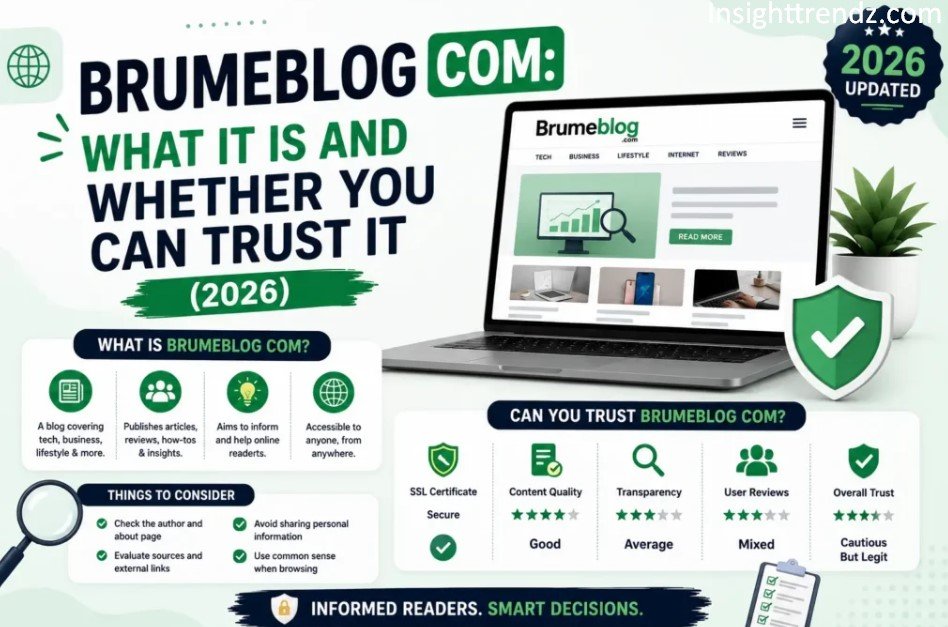
Based on available information, there are no widely reported signs of malware, phishing, or scam activity connected to Brumeblog.com. The site is generally described as freely accessible, without requiring an account or payment to read articles.
That said, “no reported problems” is not the same as “independently verified as safe.” Here’s a more useful way to think about it:
- Technical safety — No public reports currently link the site to malware distribution or credential theft.
- Content accuracy — Because there’s limited visibility into the editorial process, individual articles should be fact-checked against primary sources, especially for health, legal, or financial topics.
- Data privacy — As with any content site, avoid entering personal or payment information unless the page is clearly secured and the request makes sense for what you’re doing there.
The standard advice for any lesser-known content site applies here: read for general information, but verify anything that will influence a real decision — a purchase, a medical choice, or a financial move — against a source you already trust.
Brumeblog.com vs. Single-Niche Blogs

Here’s how a multi-niche site like Brumeblog.com typically compares to a focused, single-topic blog.
| Factor | Multi-Niche Site (like Brumeblog.com) | Single-Niche Blog |
| Topic range | Broad — many unrelated categories | Narrow — one subject area |
| Depth of expertise | Often shallower per topic | Usually deeper, more specialized |
| Search visibility | Can rank for many different keywords | Ranks strongly for related keywords |
| Editorial transparency | Frequently limited, especially for smaller sites | Often clearer, since authors specialize |
| Best used for | Quick overviews, casual browsing | Research-grade or professional-level detail |
| Update consistency | Varies widely by site | Often more predictable within its niche |
Neither model is inherently better. A multi-niche site can be genuinely useful for quick, general answers. A niche site is usually the better choice when you need depth, technical accuracy, or specialist insight.
Pros and Cons of Brumeblog.com

Pros
- Covers a wide range of topics in one place, which can save time for casual browsing
- Free to access, with no account or subscription required
- Articles are generally written in plain, accessible language
- No widely reported security or scam complaints at this time
Cons
- Limited public information about ownership, editorial standards, or fact-checking process
- Broad topic coverage can mean less depth or specialist authority per article
- Author credentials, where listed, are minimal
- Recent, sudden spike in third-party “review” articles suggests active SEO or backlink activity, which readers should factor into how much weight they give the coverage
How to Evaluate Any Content Site Like Brumeblog.com
Rather than relying only on what other sites say about a blog, it helps to have a repeatable checklist. Here’s a simple one:
- Check the “About” page. Look for a real name, background, and contact method beyond a generic form.
- Look for sourcing. Do articles link to primary sources, studies, or official data — or do they just make claims?
- Check publish and update dates. Content on fast-moving topics (tech, finance, health) should be recent or clearly dated.
- Search for the site name plus “review” or “safe.” A sudden wave of near-identical guides, as seen with Brumeblog.com, is worth noticing — it often signals coordinated SEO activity rather than organic reader demand.
- Cross-check any specific claim. Especially for health or money topics, verify against a source you already trust before acting on it.
This checklist works for evaluating any unfamiliar website, not just this one.
Should You Read or Trust Brumeblog.com?
The honest answer: it depends on what you’re using it for.
For light, general-interest reading — quick explainers, casual trend pieces, broad overviews — Brumeblog.com appears to function like many small, independent multi-niche blogs. There’s nothing in the available public record suggesting malicious intent.
For anything that requires verified expertise — medical guidance, legal interpretation, financial planning, or technical accuracy you plan to rely on — treat it the way you’d treat any site without a clearly documented editorial team: as a starting point, not a final source.
Frequently Asked Questions
1. Is Brumeblog.com a legitimate website?
There are no widely reported signs of scam activity or malware associated with the site. It appears to be a smaller, independently run content publisher rather than an established media brand.
2. Do I need to create an account to read Brumeblog.com?
No. Publicly available information indicates the site can be browsed without registering or paying for access.
3. Who owns or runs Brumeblog.com?
Public information about ownership and the editorial team is limited. Some third-party coverage points to a single listed contributor with a brief general bio, but there’s no widely disclosed company name or staff directory.
4. What topics does Brumeblog.com cover?
The site publishes across multiple categories, including technology, business, lifestyle, health, and education, rather than focusing on one niche.
5. Is Brumeblog.com the same as a traditional blog?
Not exactly. It’s structured more like a small digital magazine, covering many topics under one domain, rather than a personal blog centered on one author’s specific niche.
6. Why are so many sites suddenly writing about Brumeblog.com?
A cluster of similar “what is this site” guides appeared across multiple third-party publishers within a short period in 2026. This pattern often points to a coordinated SEO or content marketing push rather than organic reader curiosity alone.
7. Is it safe to click links or ads on Brumeblog.com?
There’s no current public report of malicious links or ads on the site. Still, general browsing caution applies — avoid entering sensitive information unless you understand exactly why a page is asking for it.
8. Can I trust health or financial articles on Brumeblog.com?
Treat any article on those topics as a general starting point rather than a final authority, and verify important details against a source with clear medical or financial credentials.
9. Does Brumeblog.com have a mobile-friendly design?
Reviews describe the site as using a standard, purchased WordPress theme, which typically includes responsive, mobile-friendly formatting by default.
10. How does Brumeblog.com make money?
This isn’t publicly confirmed. Multi-niche content sites like this one typically rely on some combination of display advertising, affiliate links, or sponsored content, though the specific model for this site hasn’t been officially disclosed.
Conclusion
Brumeblog.com is best understood as a small, independently operated, multi-niche content site — not a major media outlet, and not a confirmed scam either. It publishes broad, accessible content across technology, business, lifestyle, health, and education, with limited public detail about who’s behind it.
That combination — genuinely useful for casual reading, thin on editorial transparency — describes a lot of smaller websites competing for search traffic today. The smartest approach is the same one that works for any unfamiliar site: use it for general context, and verify anything that actually matters against a source you trust.
If you found this breakdown useful, the same evaluation checklist above will serve you well the next time an unfamiliar website shows up in your search results.